

Canola is one of Canada’s most important crops and is also the second most traded vegetable protein ingredient in the world. The vast, fertile fields of Western Canada are the primary canola production region. In early summer, canola fields dot the countryside with brilliant yellow flowers, yielding between 18-20 million metric tonnes of canola each fall. These tiny round seeds, containing approximately 44% oil, are extracted for use as one of the world’s healthiest culinary oils. After the oil is extracted, the seed solids are processed into a protein-packed meal coproduct that is an excellent addition to livestock feed.
The name “canola” (Canadian oil) was coined in order to differentiate it from rapeseed. Canola is an offspring of rapeseed (Brassica napus and Brassica campestris/rapa), that was bred through traditional plant breeding techniques to have low levels of anti-nutrients, specifically erucic acid (< 2%) in the oil portion and low levels of glucosinolates (< 30 μmol/g) in the meal portion. The near removal of the glucosinolates in canola results in a meal that is highly palatable to livestock. Some European countries use the term “double-zero rapeseed” (low erucic acid, low glucosinolates) to characterize the modified “canola quality” seed, oil and meal.
Production and Markets
Canola production in Canada has been steadily increasing, and currently sits at approximately 18-20 million metric tonnes of canola seed per year. The Canadian canola industry is targeting an increase in yield to reach 26 million metric tonnes of production per year, in response to rising world demand. The plan focuses on increasing yields in a sustainable way, while building consumer understanding of canola’s value and achieving stable, open trading relationships. As Figure 1 shows, canola production has risen steadily over the last two decades.
Global demand for canola oil and meal continues to grow, spurring investments in new processing capacity here in Canada. From 2021 to 2023, there were five major announcements to add 6.7 MMT of processing capacity in the next several years – representing a 60% increase from the current capacity of 11.1 MMT. This expansion will result in additional canola meal available for export from Canada to countries such as the U.S., China, Mexico and the Indo-Pacific region. About half of Canada’s canola seed is exported, and the other half is processed in Canada (Table 1). Most countries that import canola seed mainly do so for the oil, which is the most valuable component. The seed is processed, and the resulting canola meal is used for the animal feed industry in these countries. Canola meal is widely available and traded, usually sold in bulk form as mash or pellets.
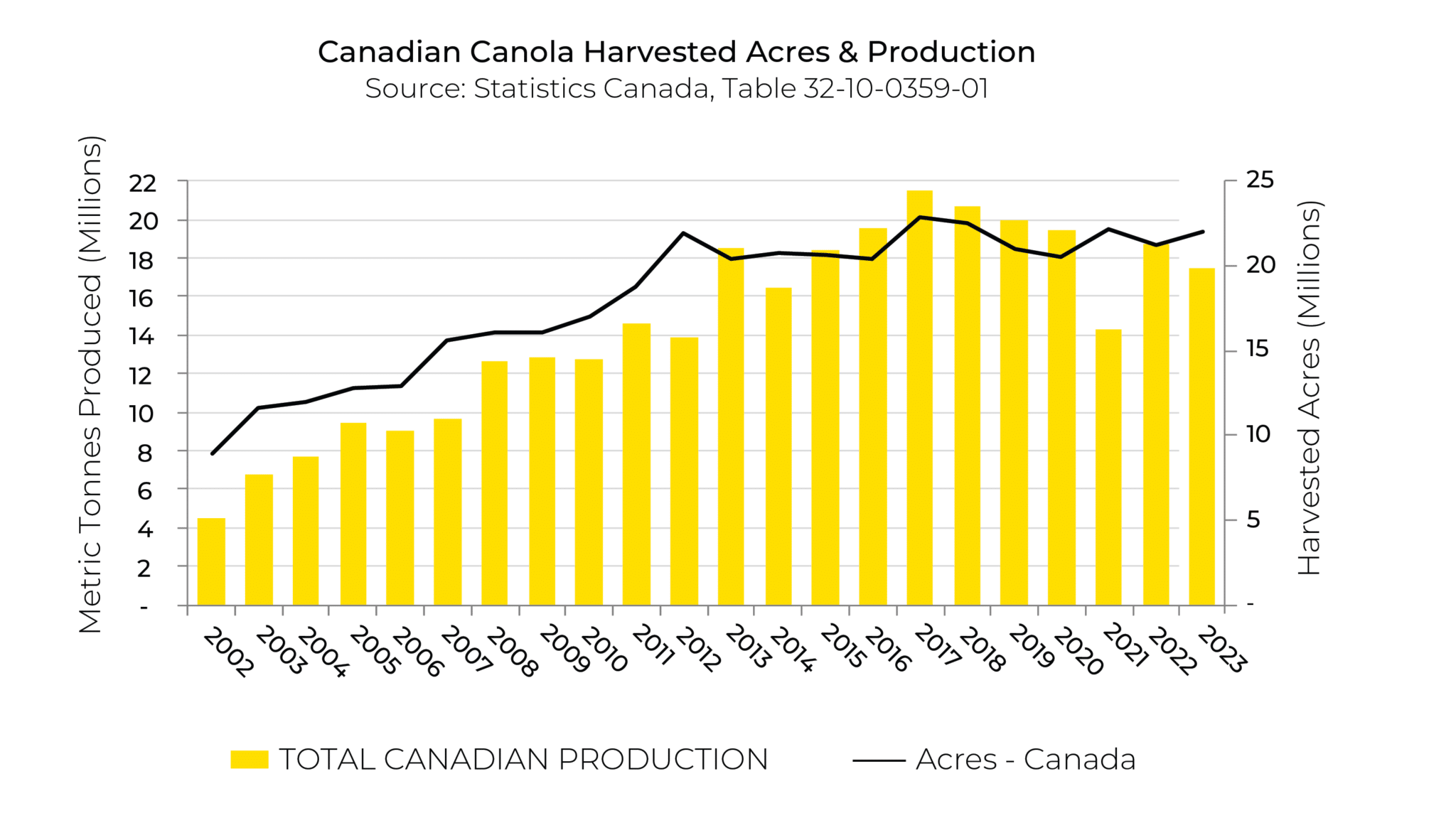
Figure 1. Total production and acres of canola from 2002 through 2023.
Canola meal is a well-researched feed ingredient for dairy cows, poultry, swine and aquaculture that consistently provides value for producers, as shown in recent academic studies. Field trials conducted in Wisconsin have shown that canola meal can be an alternative for animal proteins and can also be used to replace the high bypass protein soybean meal products that are often needed in rations balanced for amino acids.
Canadian canola meal is traded under the rules outlined in Table 2. Canola and rapeseed meals are commonly used in animal feeds around the world. Together, they are the second most widely traded protein ingredients after soybean meal. The major producers of canola and rapeseed meal are Canada, Australia, China, the European Union and India. The use of canola meal varies considerably from market to market. Canola meal sold directly to the United States goes primarily to the top dairy producing states. Canola seed exported to other countries for processing is used in a much more diverse fashion, including feeding to pigs, poultry and fish. Similarly, the meal that is used by the Canadian livestock industry goes primarily to dairy, swine and poultry rations.
Table 1. Canadian production, exports and domestic use of canola seed and canola meal (in 000’s) Metric tonnes1
| wdt_ID | wdt_created_by | wdt_created_at | wdt_last_edited_by | wdt_last_edited_at | Crop Year | 2019/2020 | 2020/2021 | 2021/2022 | 2022/2023 |
|---|---|---|---|---|---|---|---|---|---|
| 1 | canolamazing | 28/05/2025 01:12 PM | canolamazing | 28/05/2025 01:12 PM | Total seed production | 19,912.00 | 19,485.00 | 13,757.00 | 18,174.00 |
| 2 | canolamazing | 28/05/2025 01:12 PM | canolamazing | 28/05/2025 01:12 PM | Total seed export | 10,038.00 | 10,585.00 | 5,248.00 | 7,944.00 |
| 3 | canolamazing | 28/05/2025 01:12 PM | canolamazing | 28/05/2025 01:12 PM | China | 1,926.00 | 2,714.00 | 1,265.00 | 4,608.00 |
| 4 | canolamazing | 28/05/2025 01:12 PM | canolamazing | 28/05/2025 01:12 PM | Japan | 2,140.00 | 2,323.00 | 1,383.00 | 1,101.00 |
| 5 | canolamazing | 28/05/2025 01:12 PM | canolamazing | 28/05/2025 01:12 PM | Mexico | 1,154.00 | 1,374.00 | 1,035.00 | 1,208.00 |
| 6 | canolamazing | 28/05/2025 01:12 PM | canolamazing | 28/05/2025 01:12 PM | United Arab Emirates | 989.00 | 997.00 | 307.00 | 169.00 |
| 7 | canolamazing | 28/05/2025 01:12 PM | canolamazing | 28/05/2025 01:12 PM | Pakistan | 691.00 | 660.00 | 64.00 | 267.00 |
| 8 | canolamazing | 28/05/2025 01:12 PM | canolamazing | 28/05/2025 01:12 PM | European Union | 2,177.00 | 1,751.00 | 625.00 | 215.00 |
| 9 | canolamazing | 28/05/2025 01:12 PM | canolamazing | 28/05/2025 01:12 PM | United States | 495.00 | 429.00 | 537.00 | 320.00 |
| 10 | canolamazing | 28/05/2025 01:12 PM | canolamazing | 28/05/2025 01:12 PM | Other countries | 467.00 | 337.00 | 33.00 | 56.00 |
| 11 | canolamazing | 28/05/2025 01:12 PM | canolamazing | 28/05/2025 01:12 PM | Domestic seed processing | 10,129.00 | 10,425.00 | 8,555.00 | 9,961.00 |
| 12 | canolamazing | 28/05/2025 01:12 PM | canolamazing | 28/05/2025 01:12 PM | Domestic meal use | 737.00 | 625.00 | 649.00 | 528.00 |
| 13 | canolamazing | 28/05/2025 01:12 PM | canolamazing | 28/05/2025 01:12 PM | Total meal export | 4,904.00 | 5,261.00 | 4,516.00 | 5,311.00 |
| 14 | canolamazing | 28/05/2025 01:12 PM | canolamazing | 28/05/2025 01:12 PM | United States | 3,466.00 | 3,581.00 | 2,920.00 | 3,484.00 |
| 15 | canolamazing | 28/05/2025 01:12 PM | canolamazing | 28/05/2025 01:12 PM | China | 1,417.00 | 1,577.00 | 1,587.00 | 1,819.00 |
| 16 | canolamazing | 28/05/2025 01:12 PM | canolamazing | 28/05/2025 01:12 PM | Other Export | 21.00 | 103.00 | 9.00 | 8.00 |
1 Statistics Canada
Table 2. Trading rules for canola meal as set by Canadian Oilseed Processors Association (COPA)1
| wdt_ID | wdt_created_by | wdt_created_at | wdt_last_edited_by | wdt_last_edited_at | CHARACTERISTIC (AS FED) | CANADA AND U.S. | EXPORT |
|---|---|---|---|---|---|---|---|
| 1 | canolamazing | 28/05/2025 01:14 PM | canolamazing | 28/05/2025 01:14 PM | Protein, % minimum | 36 minimum | 36 minimum |
| 2 | canolamazing | 28/05/2025 01:14 PM | canolamazing | 28/05/2025 01:14 PM | Fat (oil) (typical), solvent extracted, % by mass | 2 minimum | 2 minimum |
| 3 | canolamazing | 28/05/2025 01:14 PM | canolamazing | 28/05/2025 01:14 PM | Fat (oil) (typical), expeller pressed, % by mass | 10 minimum | 10 minimum |
| 4 | canolamazing | 28/05/2025 01:14 PM | canolamazing | 28/05/2025 01:14 PM | Moisture, % by mass | 12 maximum | 12 maximum |
| 5 | canolamazing | 28/05/2025 01:14 PM | canolamazing | 28/05/2025 01:14 PM | Crude Fibre, % by mass | 12 maximum | 12 maximum |
| 6 | canolamazing | 28/05/2025 01:14 PM | canolamazing | 28/05/2025 01:14 PM | Sand and/or silica, % by mass | – | 1 maximum |
1 COPA (Canadian Oilseed Processors Association), 2019
Meal Production Methods
Most canola seed is processed using solvent extraction in order to separate the oil from the meal. This process, also called prepress solvent extraction, typically includes (Figure 2):
- Seed cleaning
- Seed preconditioning and flaking
- eed cooking
- Pressing the flake to mechanically remove a portion of the oil
- Solvent extraction of the press-cake to remove the remainder of the oil
- Desolventizing and toasting of the meal
- Drying and cooling of the meal
A small proportion of Canadian canola seed is processed by using expeller processing, also termed double pressing. The seed is expelled twice to extract oil rather than using solvent to extract the residual oil. Up to the point of solvent extraction, the process is similar to the traditional preprocess solvent extraction process. However, it excludes the solvent extraction, desolventization, and drying and cooling stages. The resulting meal has higher oil content, which can range from 8–11%.
Effects of Processing on Meal Quality

Figure 2. Schematic of prepress solvent extraction process
References
COPA, 2019. Canadian Oilseed Processors Association. Trading rules. https://copacanada.com/trading-rules/, Winnipeg, Manitoba
Daun, J.K. and Adolphe, D. 1997. A revision to the canola definition. GCIRC Bulletin. July 1997. pp.134–141


